

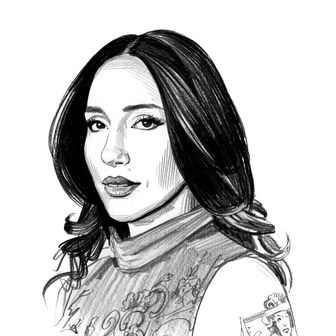

From Estefanía Vanegas Pessoa, an advice column for anyone who’s ever thought, Am I the only one feeling this way?
.
‘How Do I Keep It Professional With My Hater Co-worker?’
¡Hola, Tefi!
So, here’s the situation: I started at my current company three years ago, fresh off a job where my co-workers and I were way too close. Like, trauma-bonded-for-life close. When I joined this new company, I made professionalism my priority: polished emails, corporate mode always on, full Capricorn energy. Still, I came in cautiously optimistic that maybe I’d find a few real connections too. I’m a people person. I like to actually know my co-workers as human beings, not just colleagues.
Enter (let’s call her) Isabella. She’s around my age, so naturally I gravitated toward her. I thought, Great, someone I can chat with about life while we suffer through meetings together. But from the start, there was … an off vibe.
She loves to make little comments like, “Wow, you’re sooo good at your job,” or, “Bet you’re rolling in the big bucks,” while constantly asking how much I make (which I never share) and loudly complaining about her own salary in front of the entire office. Like, Girl, I cannot be associated with your chaos in public.
And the thing is … if I’m too professional, she accuses me of being fake, conniving, or holier than thou. If I lean into friendliness, she spends that time gossiping about everyone else in the office, which is just not my vibe. Basically no matter how I show up, she finds a way to sour the interaction. Unfortunately, I still have to see and work with her often and can’t just avoid her.
What makes it even trickier is the bigger picture. I’m one of the few younger employees in a workplace that skews white and old, and as a Black gender-nonconforming professional, I’m acutely aware that people may already be viewing me through a certain lens. I find myself constantly worrying about how I’m perceived and balancing being authentic, competent, and “acceptable” all at once. I was raised by a Black corporate-executive mother who taught me to guard my professionalism like armor, and that Isabella is constantly trying to chip away at that feels like more than just petty office drama.
So … how do I exist around someone who’s both a co-worker and a part-time, insecure hater? Do I keep the mask of professionalism on at all times, or risk being painted as a villain no matter what I do?
—Corporate Girlie
Hi, Corporate Girlie!
Okay, so. It sounds like you’re working two (2!) jobs — and the one you’re working for free is the most costly: the job of managing how you’re perceived as a young Black gender-nonconforming professional in a space that wasn’t built with you in mind. That’s real. I’m proud of you for always trying to do your best.
Now, about Isabella. Let her hate you! She is projecting her insecurities onto you, and you have worked too hard to be associated with someone who is capable of jeopardizing your growth in your industry. Trust me: You are not the only one who has felt her weird-ass energy. You have already been far too kind because imagining her calling herself “broke,” out loud, in the office, makes me feel like I’m about to break out in hives. That is so unprofessional!
A lot of people confuse intimacy with access. Isabella wants access to you — your emotions, your salary, your opinions — and when she can’t get it, she calls you “fake,” constantly testing and probing your boundaries because she knows you want to be liked and keep the peace. Your politeness is being taken advantage of and it makes me sick. And when someone’s default mode is gossip, any vulnerability you offer them will become material. Are you being careful or are you being cold? I think the former.
My best friend’s mom is a corporate, loving, protective Black mama and her youngest is a gender-nonconforming child, so I asked her for advice. (Also, I love her.) Here’s what she said:

I am rooting for you, Corporate Girlie! Boundaries are so hard when you think it’ll cost you opportunities. But please know that the only thing boundaries will cost you in this situation is a sneaky hater. You got this. If you ever feel the stress of sticking to your boundaries, imagine me and my friend’s mom cheering you on, holding up signs with your name on it, and jumping up and down every time you choose yourself.
.
‘How Do I Rebuild a Relationship With My Mom With Boundaries That’ll Protect Me?’
Dear, Tefi,
After a year of silence, my mom and I are trying to reconnect. I needed that year to grieve the mother I never really had — and to let go of the fantasy that my parents would one day become the safe, emotionally mature people I always hoped for.
Now that we’re talking again, I see two versions of her: the overwhelmed, emotionally immature mom who couldn’t care for me as a child, and the woman who tried her best in a world that’s been unkind to women like her. I can hold space for both. I want to show up for both.
But when she lashes out, especially when I’m tired or vulnerable, it brings up so much rage. I feel like I’m parenting her just to keep the peace. And in those moments, I think: Who’s taking care of me? I’ve never really felt held. I’m trying to be the cycle breaker, but some days I’m just exhausted.
How do I keep this relationship alive without constantly betraying myself?
—Tired But Trying
Hey, Tired But Trying:
The fact that you took a year of distance to grieve the mother you wish you had is such an act of self-respect. I really really believe that sometimes relationships need to breathe in order to see things clearly without having our inner child triggered and yelling in our ears. Without space, the same fight happens over and over because a part of you keeps testing to see if your mom could ever be the person you want her to be. Space was part of the work. You already did something many people never let themselves do. You let go of the fantasy so you could meet the real person in front of you.
Holding compassion for a parent’s limitations without surrendering your own boundaries is real gangster shit. Your mom did do the best she could with what she had and she sometimes harmed you. Recognizing her humanity doesn’t require you to minimize your pain. You can respect her effort and still protect yourself.
Sometimes cycle breaking means making the relationship smaller and simpler. Maybe that looks like phone calls that never cross the half-hour mark, agreeing to an occasional dinner with a nonnegotiable hard out, or only ever talking about non-touchy topics you know you won’t end up arguing over. You’re rebuilding a relationship, and it’s healthier to start small. Doses.
Just please, please, please remember: Showing up with empathy isn’t the same as being her emotional regulator. It’s okay to love her and (!) still let her sit with her own feelings instead of you rushing to soothe or manage them. The anger and grief you describe is valid and very relatable to so many people! If you haven’t already, keep a therapist, a friend, or even a journal as the place where you’re fully held and where you feel understood, not judged. That’s how you avoid handing that job back to the person who couldn’t do it in the first place.
You’re not failing because you still get tired. If that were true, we would all be failing. You’re just a human being trying to build something sturdier than what you inherited. I believe that’s cycle breaking. Proud of you.
.
‘My Friend Is Pushing Me (and Our Trauma Bond) Away — Is There Anything I Can Do?’
Dear, Tefi,
This is about my ex-bestie — we’ve been through so much together as friends. We both struggle with eating disorders, which is something we bonded and supported each other over. But when I began to feel comfortable with myself, got in a healthy relationship, and was struggling less with food, she pulled away noticeably. She started treating everyone else who was not as close to her like her best friend; it felt like I was receiving the opposite treatment. I decided to come to her and say, “Hey it bothers me that you are out with everyone else but me and when I try to make plans, you decline.” She said I made her feel like a horrible friend. Looking back, I think it has always been a one-sided competition, which is really strange because I never looked at her in that way. Whenever I would say a guy liked me or I was starting to talk to a guy, she would be like, “Yeah, he used to be obsessed with me” or, “He’s been obsessed with me. I’ve talked to him before.”
Is there anything I can — or should — do to salvage this friendship?
—Not in Competition
Heyyyy, Not in Competition,
Here’s the thing: She’s likely (understandably even!) jealous that you’re getting better, but the ED voice in her head is telling her that healing means giving up all of her coping mechanisms that have kept her thin and in control. You betrayed her ED voice and now she’s also aware you know all her tricks and will know if she’s lying about recovery, or maybe she’s scared about being pressured to actually recover. I say this because I’ve been there — I think most women with ED have been there.
It’s like any toxic relationship: The worst thing that can happen is that it’s over. When you began to move out of that cycle of struggling with food and started building a healthy relationship, you stopped speaking the same “language of pain” that used to connect you. For someone who isn’t ready to leave that space yet, your growth can feel like rejection even if you never meant it that way and you’re just trying to survive. It sounds like her distance, and those nasty “he was obsessed with me first” passive-aggressive comments, have less to do with you and more to do with her own insecurity.
If the foundation of the friendship was partly a sense of shared struggle, your healing felt like a threat. A friendship can change shape. Maybe it’s no longer a best friendship but a check-in friendship: a “thinking of you” text, a coffee once in a while, a funny meme in the DMs. In any case, trying to drag it back to what it was might keep you both stuck.
I believe in the power of a reframe: The bond you had was real … for the time it was needed. It doesn’t mean you failed or that the friendship was fake in any way, shape, or form. It just means that your paths and what each of you needs in a friend right now aren’t the same. Maybe she doesn’t want a real friend right now. It’s easier to hide your secrets around people who don’t know you, hence the gravitation pull to strangers you described.
Sometimes the most loving thing you can do for an old friend is to keep growing, and hope they choose to catch up. Keep going.
Send your questions to asktefi@thecut.com (and read our submission terms here).
More From This Column
- ‘I Like Someone 7 Years Older Than Me — Is Dating Them a Bad Idea?’
- ‘He Tried Winning Me Back After Our Breakup — While Being With Someone Else?’
- ‘When Is a Second Date Worth the Trouble?’