



“Are you good under pressure?” Sagar Radia asks me midway through our first bowling match. It’s noon on a Friday and the 38-year-old Industry star and I are enjoying Pepsi and overcheesed pizza in a nearly empty bowling alley in Times Square. Nearby, a group of teenagers playing hooky take turns at their lane as 2010s pop music videos — a lot of One Direction and Charlie Puth — play in the background. There’s an antiseptic smell in the air. Neither Radia nor I has bowled in years, so he proposes a gentlemen’s agreement: I don’t publish our scores unless they’re suitably impressive.
It’s the kind of scheme Rishi Ramdani, the fast-talking trader Radia has played for four seasons on HBO’s lurid banking drama, would put money on. A supremely abrasive yet fan-favorite character slightly older than the recent grads who surround him at a London-based investment firm, Rishi spent most of Industry’s first season delivering an incessant stream of lewd commentary — “He’s a limp-dick analyst, but he has a view”; “I don’t wanna see anything else apart from his balls” — on the Pierpoint & Co. trading floor. (Radia jokes that, when Industry first season started airing, he would get more compliments on that dialogue, mostly recorded in post-production, than his onscreen performance.) But as the series matured from soapy workplace drama into sweaty financial thriller, Rishi’s cocksure grasping epitomized both the more-is-more fixations of the capitalist class and the show’s own expanding narrative ambitions. Rishi does coke and hooks up with Myha’la’s power-hungry American Harper Stern in the bathroom at his wedding to a posh white socialite. A standout season-three episode, “White Mischief,” chronicles his attempts to assimilate into life in the British countryside and shrug off a massive gambling debt; the season finale culminates in Rishi’s debtors executing his wife at their kitchen table. Industry creators Konrad Kay and Mickey Down take pride in writing themselves into a corner at the end of each season, which meant pushing Radia to the bottom of the rabbit hole in its fourth.
In person, Radia’s fastidiously polite and a bit reserved — he’s wearing a cozy cream-colored sweater and speaks far more softly and slowly than his character’s machine-gun delivery. But I see glimmers of Rishi’s self-certainty during our bowling match. While I pull ahead in our first round with an accidental strike, Radia, a far more consistent bowler and regular amateur soccer player, pulls out a spare to win on the last frame. I lose in our second round, too, much more handily. “I’m a pressure guy,” Radia says by way of explanation. It’s that confidence Kay and Down responded to when, after season one, Radia sat them down and explained his concerns about getting stuck in a minor part. “We fell in love with his swagger,” they tell me. “Rishi’s confidence as an orator and wise-cracker informed Sagar, and it was a kind of virtuous cycle where Sagar grew until we knew we could saddle him with a huge episode like ‘White Mischief.’”
If the stress of that episode spiked your heart rate, then season four’s “1000 Yoots, 1 Marilyn” may give you arrhythmia. In the aftermath of his wife’s death, Rishi is a ghost in his own life: Whispers of his fall from polite society follow him wherever he goes, and Radia’s eyeballs appear recessed to the back of his skull. He spends his days fighting a losing battle with his mother-in-law for custody of his son and filming blowjobs from prostitutes to get himself off. At night, he’s doing humiliating financial spycraft for Harper, who needs oppo research for her fund that’s betting on other company’s downfalls. When she tasks him with getting information out of financial journalist James Dyker (played by Stranger Things’s Charlie Heaton), also an addict, the two spend a manic night in an apartment together getting high. “The sesh from hell,” Kay and Down nicknamed this sequence, because, “what is hell if not a coked-up Yorkshireman monologuing about the societal ills of late-stage capitalism?”
Directed by Michelle Savill and filled with drugs, phone screens, and a chilling detachment, the scene that follows is Industry distilled to crystal form: When James asks what it was like to see his wife die, Rishi dissociates into the memory of his dead wife’s face. He heads to the bathroom for more coke, emerges to discover that James has overdosed just as the police knock at the door, and darts to the balcony to escape. As the cops enter the apartment, Rishi jumps off. “He wants out of the room but really, he wants out of the prison of his actions, his drives, his impulses, his insecurities: the things that the system feeds on and exacerbates,” Kay and Down told me. “Does he care if he dies on the way down?” In a dark punchline typical of Industry, Rishi survives, but as he tries to crawl away on mangled, bleeding legs, he’s arrested. To Radia, there’s humor to the fact that, of course Rishi wasn’t going to escape so easily, even if his last-ditch attempt at evading responsibility was suicide. “There’s a moment at the end of that episode where he almost has a slight grin on his face,” Radia says. “I think he feels like he got what he deserved. Something had to happen for him to take responsibility for his actions. That moment he was being arrested, it kind of felt like, Okay, this is right.”
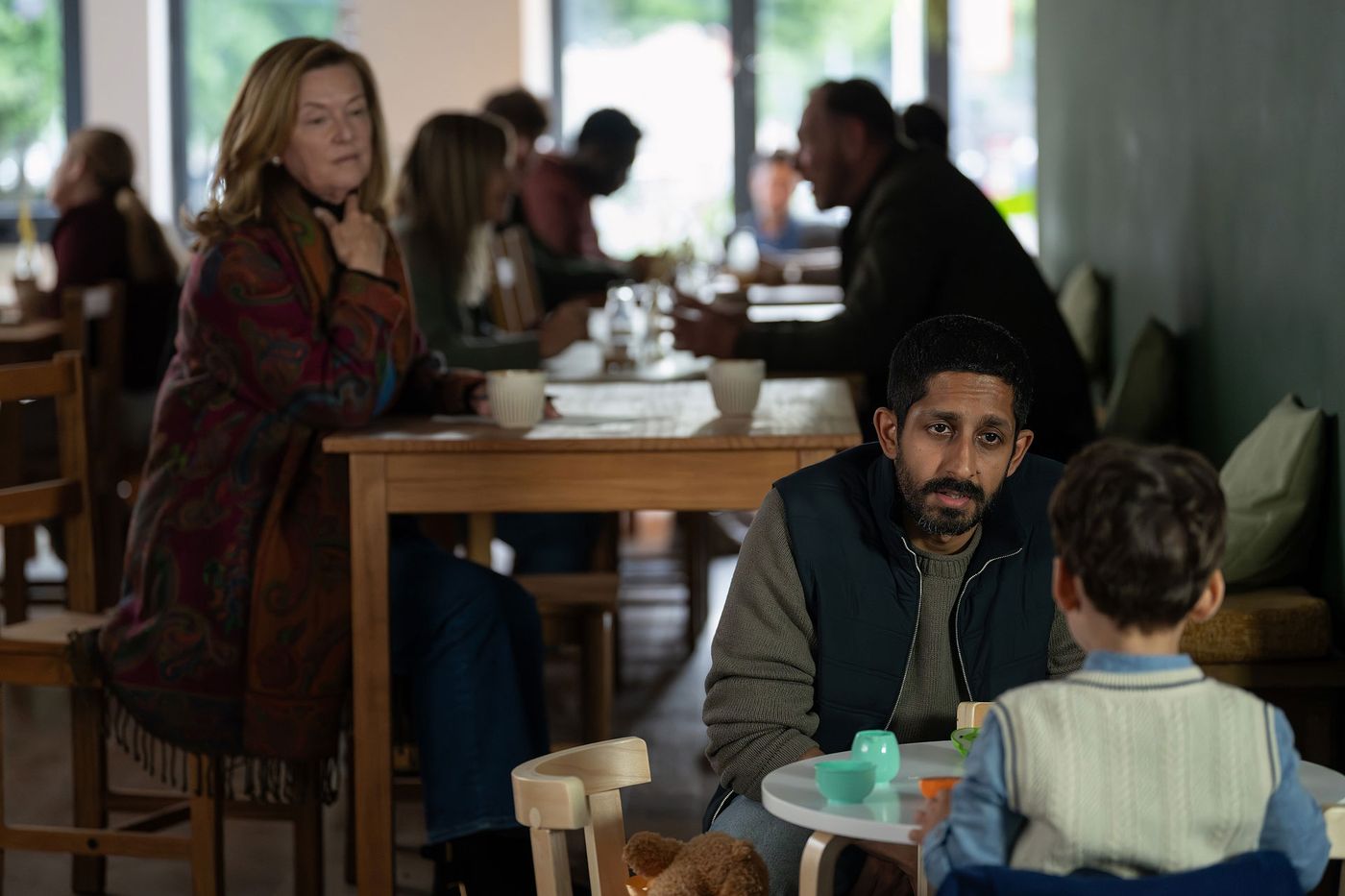
It’s a gruesome, mordant good-bye, set to the tune of Alphaville’s “Forever Young” — which ends up being an accidental hat tip; “White Mischief” was heavily inspired by the Safdie brothers’ Uncut Gems, and the Industry team had locked their cut of this scene before learning the same song appears in Josh Safdie’s Marty Supreme. This is the last we see of Rishi this season, and possibly on Industry, too: Radia describes the process of filming the episode as a swan song. When Radia filmed his final scene, in which Rishi brings information to Harper, Eric, and Sweetpea, colleagues he once happily berated with locker room talk on the trading floor, Kay and Down showed up to observe even though they weren’t directing. Radia describes a low-key and very British good-bye. “They said some nice words, I said some nice words,” he remembers. “Is there room to come back? Never say never, but we’d have to figure out what it looks like. I think this is a nice way for him to close off — you want to go at a time when people want more of him.”
Radia has followed his own sense of timing instinctively throughout his career. He fell into acting, not your typically stable field, he jokes, when a friend who’d been a child actor suggested he check out after-school acting classes. He spent his early 20s trying to land stable work with the limited roles available to South Asian men. “A lot of cab drivers, terrorists, and the best friend,” he says, “Not to say there weren’t places for those stories, but they weren’t my experience or the stories I wanted to be a part of.” By 25, he gave up, left his agent, took a job placing sales at an ad agency for six months, and realized he couldn’t endure it. In 2016, he landed his break as understudy to Kunal Nayyar (of The Big Bang Theory) in the London run of Jesse Eisenberg’s play The Spoils, where Eisenberg and Nayyar played roommates. When Nayyar left the run to film his sitcom, Radia got to step up into his role. “Jesse was an absolute delight, making time to rehearse with me, a pure artist,” Radia remembers. “That play really changed my life.”
The run raised Radia’s profile enough that he got an audition for an ITV medical drama called The Good Karma Hospital, built around a white British woman who relocates to Southern India. Radia landed the part of a layabout son of the head of the hospital and found himself flying to set in Sri Lanka, where he filmed for three seasons. Then came an audition for Industry, which initially looked like a low-commitment gig with a high upside: a small role in a new HBO show with a young cast that could go somewhere big, or not. He thought he’d film Industry, then go back to the relative stability of Good Karma, but after Industry’s first season, he had to choose between the two. Kay and Down had promised more for Rishi, but what did that mean? “I thought, why not?” Radia says. “I said no to the other job.”
For all of Rishi’s intensity and blustering, like the way Radia throws his arms wide and reigns over his desk like a king in the show’s early seasons, the secret to Rishi’s appeal lies in the actor’s understanding of the gaps in his character’s armor. Radia sees so much of Rishi as driven by a second-generation immigrant’s impulse to assimilate. He was pleased when Kay and Down decided to have Rishi’s wedding be a stridently British country affair, instead of a traditional Indian wedding, because it signified how desperately Rishi wanted to be part of the Establishment. You can feel what Rishi has sacrificed to make himself fit in; in “White Mischief,” for instance, we learn he’s named a dog Rajah, like the tiger from Aladdin. Growing up among other children of immigrants, Radia knew men like Rishi, who chased their way into unforgiving institutions and high-earning jobs. “His confidence, his bravado, his jokes, were his way of allowing everyone else to feel comfortable around him,” says Radia. “It’s a defense mechanism. If they see any weakness, it can be taken advantage of.”
Radia’s ability to melt the harshness of his character to unveil an, if not cuddly, then at least sympathetic core, has built him an if-you-know-you-know army of fans along the way. At dinner in London recently, John Legend saw Radia, did a double take, then came up to tell him he was watching his show right now. (When Legend’s wife, Chrissy Teigen, appeared, Legend told her, “Look, it’s the guy from Industry.”) When Radia ran into Chris Rock in Soho, the comedian immediately brought up the series. Radia is reticent to discuss future plans, but talks about forthcoming roles with the measured sense of someone who’s seen boom and bust times in his career. As we finish eating and Ariana Grande’s “Thank U, Next” plays over the loudspeakers, Radia turns reflective. “He was so fun to play,” he says, seemingly still getting used to the past tense, “because I’m certainly not that guy. I never was that guy.” When he meets people who’ve seen the show, he worries that they want to meet Rishi and he can’t deliver. “But then, actually, a lot of the time they’re like, no, no no,” he says, with relief. “Nobody wants to meet Rishi. They love watching him from afar.”
More ‘Industry’
- The Best TV of the Year So Far
- On Industry, It All Comes Back to the Watch
- Industry Season-Finale Recap: Made in Reality